
The Long Wave of Prediction Markets
What's really going on, beyond storytelling on Polymarket

«Never underestimate a man who overestimates himself» — Charlie Munger
If we want to understand what prediction markets are and why they are attracting so much attention today, we need to start with a simple but often overlooked fact: they are not a new idea. They have been around for decades. In the 1980s and 1990s, they were already being used in academic and institutional settings and one of the best-known examples is the Iowa Electronic Markets, which was used to predict election outcomes in the United States with results that were often more accurate than traditional polls.
The difference is that today, with platforms like Polymarket, these tools have become accessible, liquid, and above all, global. You no longer need to be a researcher or an institution: anyone can take a position on an event. The mechanism is simple in structure but powerful in its effects and every event is transformed into a binary or multiple-choice market. Let’s look at some concrete examples.
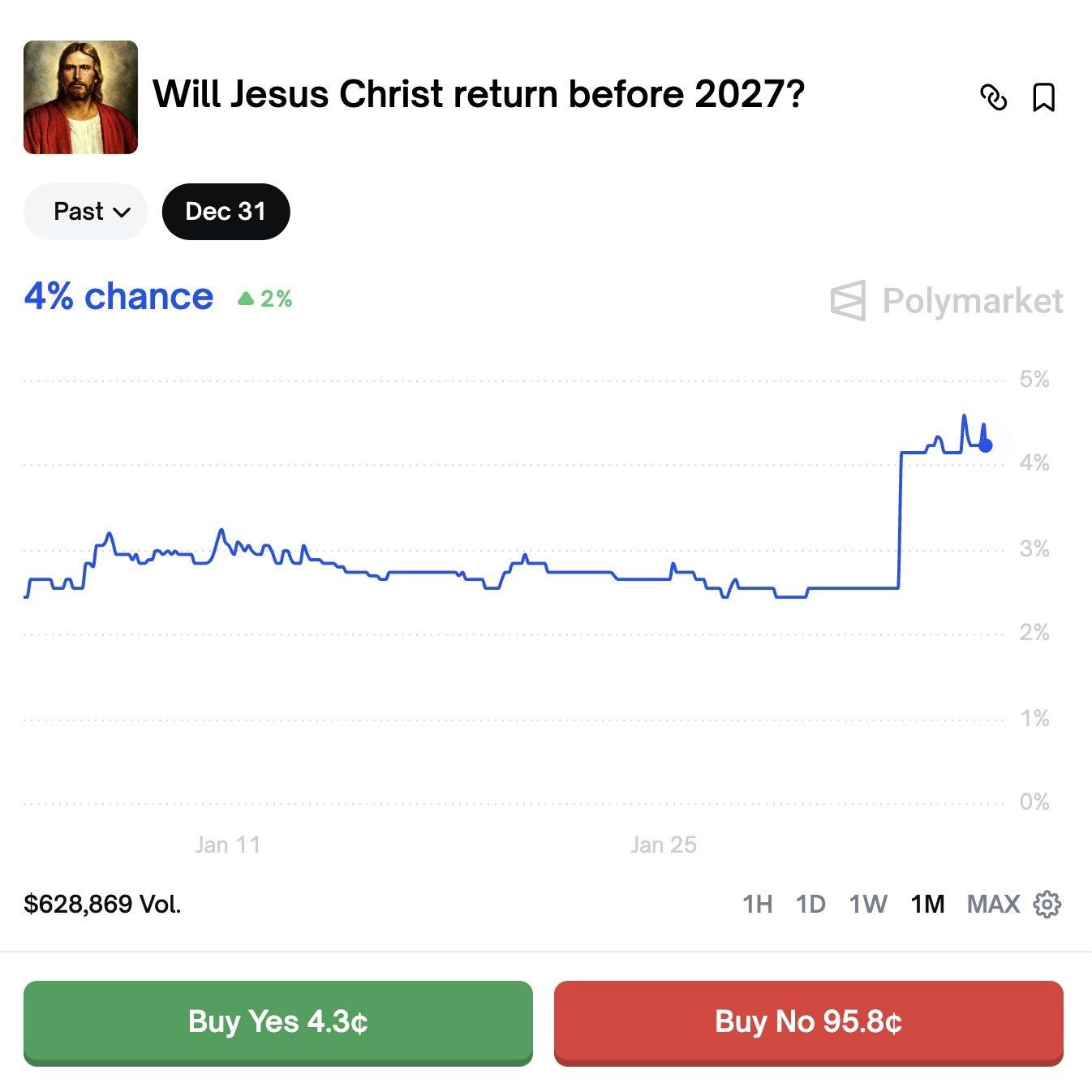
«Will Candidate X win the election?» There are two assets: YES and NO. If the YES contract is priced at 0.62, it means the market is pricing in a 62% probability that the event will occur. If you buy at 0.62 and event happens, you collect 1. If it doesn’t happen, you lose your stake. Another of the most emblematic and also most misunderstood examples is the one related to Jesus Christ. On Polymarket, there is (and it has been much discussed) a market that prices the return of Christ by a certain date. Today, for example, the «return before 2027» market is trading around 3–4% on the Yes side, with volumes exceeding tens of millions of dollars.
Now, if you look at it superficially, it seems crazy: is someone really pricing a theological event? Buying «No» in such a market is, in fact, equivalent to building a position with an almost certain return. If the price of «Yes» is at 4%, «No» is implicitly yielding something close to 96% at maturity, on a nominal basis. Annualized, it becomes a sort of «like a bond»: low yield but perceived as safe.
But the market isn’t really pricing in the probability of Christ’s return; rather, it’s pricing in the payoff: those buying «No» are seeking yield. Even extreme, seemingly impossible events never go to zero. That 3–4% isn’t faith; it’s a combination of inefficiencies, small traders, optionality and in some cases, pure noise, but above all, it’s the price necessary for counterparty to exist. The risk isn’t that Christ will return, but rather operational, structural and liquidity risks. Because you’re buying a payoff defined by rules (purchasing on a platform trades cryptocurrencies, ed.). In other words, this type of market seems like an easy return, but in reality it is much closer to imperfect arbitrage than to a risk-free investment. And it is exactly the kind of distortion that prediction markets make visible.
«Non sottovalutare mai un uomo che si sopravvaluta» — Charlie Munger
Se oggi cerchiamo di capire cosa sono i prediction market e perché stanno attirando così tanta attenzione, dobbiamo partire da un punto semplice ma spesso ignorato: non sono un’idea nuova. Esistono da decenni. Negli anni ’80 e ’90 venivano già utilizzati in ambito accademico e istituzionale, e uno dei casi più noti è l’Iowa Electronic Markets, che veniva usato per stimare gli esiti elettorali negli Stati Uniti con risultati spesso più accurati dei sondaggi tradizionali.
La differenza è che oggi, con piattaforme come Polymarket, questi strumenti sono diventati accessibili, liquidi e soprattutto globali. Non serve più essere un ricercatore o un’istituzione: chiunque può prendere una posizione su un evento. Il funzionamento è banale nella struttura ma potente negli effetti e ogni evento viene trasformato in un mercato binario o multiplo. Facciamo alcuni esempi concreti.
«Il candidato X vincerà le elezioni?». Ci sono due asset: YES e NO. Se il contratto YES quota 0,62, significa che il mercato sta prezzando una probabilità del 62% che quell’evento si verifichi. Se compri a 0,62 e l’evento accade, incassi 1. Se non accade, vai a zero. Un’altro tra gli esempi più emblematici, e anche più fraintesi, c’è quello legato a Gesù Cristo. Su Polymarket esiste (ed è stato molto discusso) un mercato che quota il ritorno di Cristo entro una certa data. Oggi, per esempio, il mercato «return before 2027» scambia intorno al 3-4% sul lato Yes, con volumi che hanno superato decine di milioni di dollari.
Ora, se lo guardi superficialmente, sembra una follia: qualcuno sta davvero prezzando un evento teologico? Comprare No in un mercato del genere equivale, di fatto, a costruirti una posizione a rendimento quasi certo. Se il prezzo del Yes è al 4%, il No sta implicitamente rendendo qualcosa vicino al 96% a scadenza, su base nominale. Annualizzato, diventa una specie di «pseudo bond»: rendimento basso ma percepito come sicuro.
Ma il mercato non sta davvero stimando la probabilità del ritorno di Cristo, bensì il payoff: chi compra No sta cercando rendimento. Anche eventi estremi, apparentemente impossibili, non vanno mai a zero. Quel 3-4% non è fede, è una combinazione di inefficienze, piccoli trader, optionality e in alcuni casi, puro rumore, ma soprattutto è il prezzo necessario per far esistere la controparte. Il rischio non è che torni Cristo, ma operativo, di struttura e di liquidità. Perché stai comprando un payoff definito da regole (acquisto in una piattaforma che scambia cripto-valute, ndr). In altre parole, questo tipo di mercato sembra una rendita facile, ma in realtà è molto più vicino a un arbitraggio imperfetto che a un investimento risk-free. Ed è esattamente il tipo di distorsione che i prediction market rendono visibile.
«Picking up» information
During the 2020 U.S. presidential election, betting platforms showed very rapid fluctuations in response to even partial news reports. As the first results came in from key states, odds shifted in real time, long before the media updated their official projections. At times, markets overestimated Donald Trump’s chances in the early hours of the vote count, only to correct themselves rapidly as more complete data came in. This is a useful example because it demonstrates both speed and error: market reacts first, but it is not infallible.
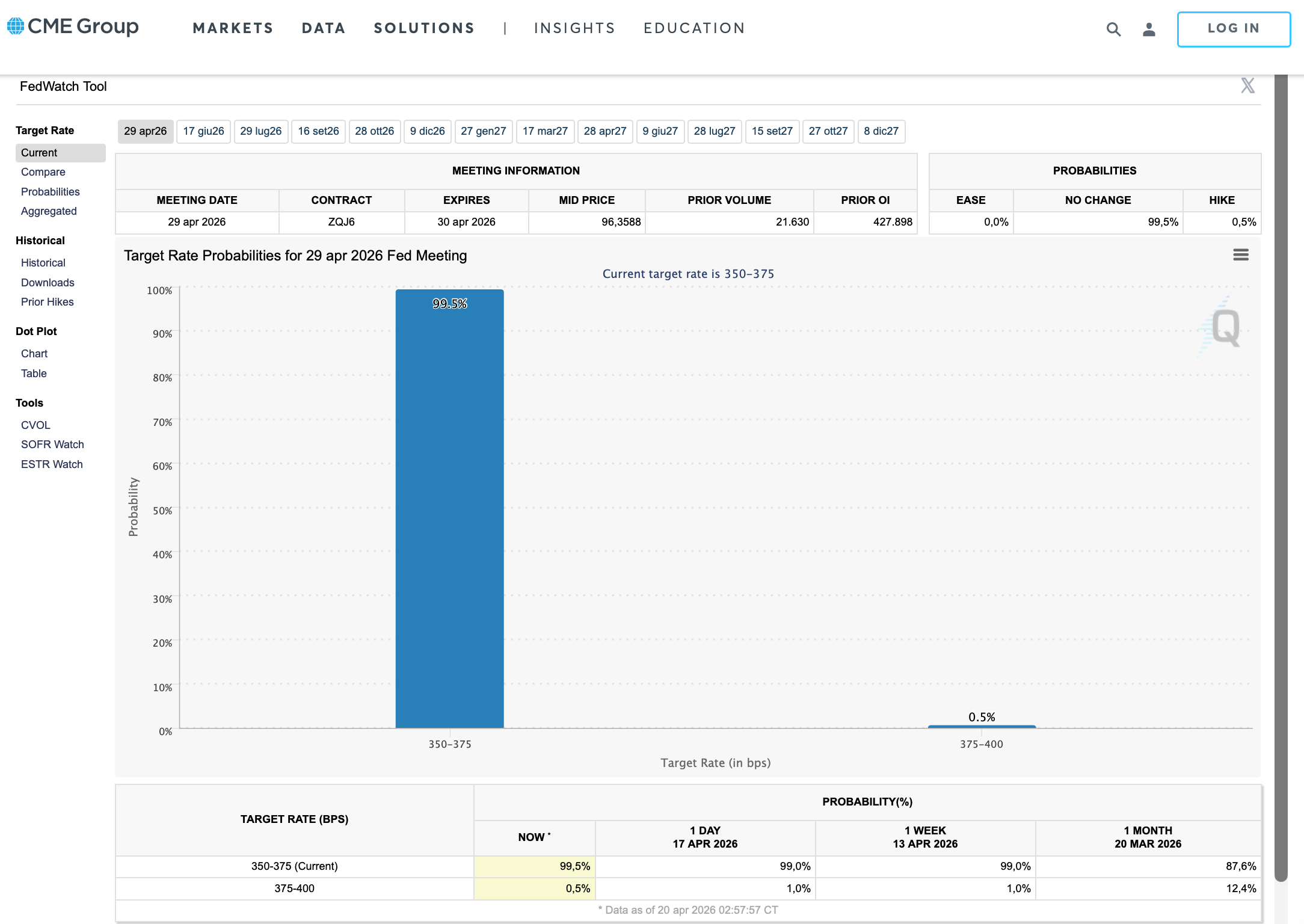
Another interesting case involves macro events. On Polymarket, events such as «Will the Federal Reserve cut rates by a certain date?» were listed. Here, the natural comparison is with traditional instruments like Fed Funds. In many times, prediction markets have shown probabilities that diverged from the futures market, especially when the context was uncertain. This creates a concrete situation: two markets pricing the same event differently and for those who know how to read them, this is information.
Then there are the more «micro» cases, but no less interesting. Regulatory decisions, approvals of financial instruments, outcomes of legal cases, corporate results. For example, when the approval of spot Bitcoin ETFs in the United States was being discussed, prediction markets began pricing in increasing probabilities weeks before the SEC’s official announcement. Not because they had direct access to insider information in the strict sense, but because they aggregated scattered signals: statements, timelines, precedents and trader behavior. This is the key point: prediction markets don’t know something beforehand; rather, they aggregate information.
And they do so through a mechanism tends to filter out noise. If someone has information or a strong conviction, they can translate it into a position. If position is correct, it is rewarded. If it is wrong, it is punished. Over time, this process tends to move the price toward an increasingly efficient estimate.
«Cogliere» l’informazione
Durante le elezioni presidenziali USA del 2020, piattaforme di scommesse su eventi mostravano oscillazioni molto rapide in funzione di notizie anche parziali. Quando arrivavano i primi risultati da stati chiave, le probabilità si muovevano in tempo reale, molto prima che i media aggiornassero le proiezioni ufficiali. In alcuni momenti, i mercati hanno sovrastimato le possibilità di Donald Trump nelle ore iniziali dello spoglio, salvo poi correggersi rapidamente man mano che arrivavano dati più completi. Questo è un esempio utile perché mostra sia la velocità sia l’errore: il mercato reagisce prima, ma non è infallibile.
Un altro caso interessante riguarda eventi macro. Su Polymarket sono stati quotati eventi come «La Federal Reserve taglierà i tassi entro una certa data?». Qui il confronto naturale è con strumenti tradizionali come i Fed Funds. In diversi momenti, i prediction market hanno mostrato probabilità divergenti rispetto al mercato dei futures, soprattutto quando il contesto era incerto. Questo crea una situazione concreta: due mercati che prezzano lo stesso evento in modo diverso e per chi sa leggerli, questa è un’informazione.
Poi ci sono i casi più «micro», ma non meno interessanti. Decisioni regolatorie, approvazioni di strumenti finanziari, esiti di cause legali, risultati aziendali. Ad esempio, quando si discuteva dell’approvazione di ETF spot su Bitcoin negli Stati Uniti, i prediction market hanno iniziato a prezzare probabilità crescenti settimane prima dell’annuncio ufficiale della SEC. Non perché avessero accesso diretto a informazioni privilegiate in senso stretto, ma perché aggregavano segnali dispersi: dichiarazioni, tempistiche, precedenti, comportamento degli operatori. Questo è il punto chiave: i prediction market non sanno qualcosa prima, bensì aggregano informazioni.
E lo fanno con un meccanismo che tende a filtrare il rumore. Se qualcuno ha un’informazione o una convinzione forte, può tradurla in una posizione. Se quella posizione è corretta, viene premiata. Se è sbagliata, viene punita. Nel tempo, questo processo tende a spostare il prezzo verso una stima sempre più efficiente.
Underestimated factors and inefficient predictions
It’s easier said than done. And while this concept is based on objective data, it remains largely theoretical. In practice, however, several things happen that are worth observing closely.
The first is liquidity, because not all markets on Polymarket are equally liquid. Some highly followed events have deep order books and narrow spreads; others are thin, with few participants. In these cases, it takes very little capital to move the price significantly. This means that probability you see isn’t always robust.
The second is concentration. It’s not necessarily the case that the market is composed of thousands of small, independent participants. In some cases, a few players with significant capital can influence the price. This doesn’t necessarily imply intentional manipulation, but it does mean consensus may be less widespread than it appears.
The third factor is thematic bias. In political markets, for example, distortions related to the composition of the user base are often observed. If a platform has a certain dominant demographic, this can be reflected in prices, especially in less liquid markets. It is no different from what happens on social media, but here it has a direct impact on price.
As we have seen, when it comes to politics, probabilities remain stuck at unrealistic levels for long periods, only to correct sharply when new liquidity or more reliable information becomes available. This behavior is typical of inefficient markets. Another practical issue concerns the resolution of events: in prediction markets, every contract must have precise rules regarding when and how it is considered «resolved». It may seem like a technical detail, but it isn’t. There have been cases where ambiguity in the rules has led to disputes or borderline situations. For example, what exactly does «by the end of the year» mean? Which source is considered official? If an event is postponed or redefined, how is the contract handled? All these variables affect the price because they introduce risk.
Then there is the issue of timing. Prediction markets are highly reactive, but this reactivity can lead to overreactions. Incomplete or misinterpreted news can push the price in one direction, only to be corrected later. This creates movements that, to the observer, are informative: they indicate not only what the market thinks, but also how sensitive it is to certain inputs. A typical example is the publication of rumors: a rumor about a possible political decision can rapidly increase the probability of an event. If the rumor is denied, the price retraces (does this remind you in some way of Mr. Trump’s TACO trade?). In the meantime, however, there was an exchange of capital, and this remains a signal nonetheless.
Finally, there is the comparison with other forecasting tools: polls, statistical models, qualitative analysis. Prediction markets often perform better because they continuously update probabilities. A poll is a static snapshot; market is a continuous flow. But this doesn’t mean they are always superior. In contexts where information is scarce or distorted, even the market can be wrong. If you try to bring these elements together, what emerges is not a magic tool but an infrastructure with specific characteristics: fast, responsive, economically incentivized, but also imperfect, sensitive to liquidity and the composition of participants.
For those working in the markets or in consulting, the practical use is not to follow these probabilities as if they were definitive forecasts. Knowing them is good and right, as well as complementing them with other sources. Look at where they diverge, when they move, how they react to information; in some cases they anticipate, in others they follow. In some cases, they signal something the rest of the market hasn’t priced in yet; in others, they simply reflect noise.
It’s another layer of information, not the only one, not the definitive one, but distinct enough to warrant attention, especially now that participation is rising and platforms like Polymarket are bringing these mechanisms out of a niche and into a much broader context. Information globalization.
Fattori sottovalutati e previsioni inaffidabili
Tra il dire e il fare, c’è di mezzo il mare. Ed è vero anche in questo caso che, seppur basato su dati oggettivi, resta molto teorico. Nella pratica invece, succedono diverse cose che vale la pena osservare da vicino.
La prima è la liquidità, perché non tutti i mercati su Polymarket sono liquidi allo stesso modo. Alcuni eventi molto seguiti hanno book profondi e spread ridotti; altri sono sottili, con pochi partecipanti. In questi casi, basta poco capitale per muovere il prezzo in modo significativo. Questo significa che la probabilità che vedi non è sempre robusta.
La seconda è la concentrazione. Non è detto che il mercato sia composto da migliaia di piccoli partecipanti indipendenti. In alcuni casi, pochi attori con capitale rilevante possono influenzare il prezzo. Questo non significa necessariamente manipolazione intenzionale, ma implica che il consenso può essere meno distribuito di quanto sembri.
La terza è il bias tematico. Nei mercati politici, per esempio, si osservano spesso distorsioni legate alla composizione della base utenti. Se una piattaforma ha una certa demografia prevalente, questo può riflettersi nei prezzi, soprattutto in mercati meno liquidi. Non è diverso da quello che succede nei social, ma qui ha un impatto diretto sul prezzo.
Come abbiamo visto, quando si parla di politica le probabilità rimangono ancorate a livelli poco realistici per lunghi periodi, per poi correggersi bruscamente quando arriva liquidità nuova o informazioni più solide. Questo comportamento è tipico dei mercati inefficienti. Un altro aspetto pratico riguarda la risoluzione degli eventi: nei prediction market, ogni contratto deve avere regole precise su quando e come viene considerato «risolto». Sembra un dettaglio tecnico, ma non lo è. Ci sono stati casi in cui l’ambiguità nelle regole ha creato dispute o situazioni borderline. Ad esempio, cosa significa esattamente «entro fine anno?» Quale fonte è considerata ufficiale? Se un evento viene rinviato o ridefinito, come viene trattato il contratto? Tutte queste variabili incidono sul prezzo, perché introducono rischio.
C’è poi il tema del timing. I prediction market sono molto reattivi, ma questa reattività può generare over-reaction. Notizie incomplete o interpretate male possono spingere il prezzo in una direzione, salvo poi essere corrette. Questo crea movimenti che, per chi osserva, sono informativi: indicano non solo cosa il mercato pensa, ma anche quanto è sensibile a certi input. Un esempio tipico è la pubblicazione di indiscrezioni: una voce su una possibile decisione politica può far salire rapidamente la probabilità di un evento. Se la voce viene smentita, il prezzo rintraccia (vi ricorda in qualche modo il TACO trade di Mr. Trump?). In mezzo, però, c’è stato uno scambio di capitale e questo rimane pur sempre un segnale.
Infine, c’è il confronto con altri strumenti previsionali. Sondaggi, modelli statistici, analisi qualitative. I prediction market spesso performano meglio perché aggiornano continuamente la probabilità. Un sondaggio è una fotografia statica, il mercato è un flusso continuo. Ma questo non significa che siano sempre superiori. In contesti dove l’informazione è scarsa o distorta, anche il mercato può sbagliare. Se provi a mettere insieme questi elementi, quello che emerge non è uno strumento magico ma un’infrastruttura con caratteristiche precise: veloce, reattiva, incentivata economicamente, ma anche imperfetta, sensibile alla liquidità e alla composizione degli operatori.
Per chi lavora nei mercati o nella consulenza, l’utilizzo concreto non è seguire queste probabilità come fossero previsioni definitive. Conoscerle è cosa buona e giusta, oltre che affiancarle ad altre fonti. Guardare dove divergono, quando si muovono, come reagiscono alle informazioni; in alcuni casi anticipano, in altri inseguono. In alcuni casi segnalano qualcosa che il resto del mercato non ha ancora prezzato, in altri riflettono semplicemente il rumore.
È un altro layer informativo, non l’unico, non il definitivo, ma abbastanza diverso da meritare attenzione, soprattutto adesso che la partecipazione è in aumento e che piattaforme come Polymarket, stanno portando questi meccanismi fuori da una nicchia e dentro un contesto molto più ampio. Globalizzazione informativa.